The future of food innovation: Five priorities for R&D leaders
I spent two days at the Future Food-Tech Conference in London last week, listening to conversations spanning healthier ageing and GLP-1s, climate resilience, novel ingredients, AI, reformulation and the challenge of scaling food-tech innovation.
R&D teams are being asked to do more with less; to create products that deliver more nutrition, use more resilient and sustainable ingredients, respond to rapidly changing technologies and health needs and communicate increasingly complex science in a way that people can understand and trust. But, however sophisticated the science becomes, first and foremost on the product developers list, is to create food that tastes delicious.
I spent two days at the Future Food-Tech Conference in London last week, listening to conversations spanning healthier ageing and GLP-1s, climate resilience, novel ingredients, AI, reformulation and the challenge of scaling food-tech innovation. Here are five of my biggest takeaways, and what I think they mean for R&D.
1. Experience is the non-negotiable
Whether the discussion was about healthier foods, sustainable ingredients, GLP-1s or alternative proteins, speakers repeatedly came back to taste, texture and enjoyment.
This was brought to life in the opening talk from Alchemist chef Rasmus Munk, whose ambition to change the world through gastronomy is taking him from one of the world’s most innovative restaurants into scientific research and food innovation. His work explores how radically different and more sustainable ingredients and processes can become exceptional food experiences, with gastronomy and pleasure setting the bar rather than being sacrificed in pursuit of sustainability.
The same principle carried through into more mainstream food innovation. In the session on building the next generation of healthy foods, Zibi Lewicki, Chief Research, Design & Innovation Officer at The Magnum Ice Cream Company, talked about the opportunity for “impossible pleasure”: bringing together nutrition and pleasure rather than assuming that improving one has to come at the expense of the other.
So what for R&D?
→ Define the core sensory Jobs to Be Done amongst target consumers early in development, then translate these into Product Attributes and understand the trade-offs to determine the Must Haves and Delighters for in-mouth enjoyment.
→ Sensory evaluation needs to run throughout development, from early prototypes through scale-up and final validation, using the right combination of validated expert panels and target consumers. It is much harder to recover a great consumer experience at the end of development if it has gradually been engineered out along the way.
2. Every bite may need to work harder
“Nutrition per bite” was a phrase that stayed with me from the discussions around GLP-1s. As appetite patterns change for some consumers, the challenge becomes how to deliver sufficient nutrition through less food, while healthy ageing is also creating demand for products that support changing nutritional needs.
Protein featured heavily, but so did fibre, nutrient density, satiety and the importance of maintaining enjoyment. Zibi Lewicki gave the interesting example of older people at risk of malnutrition who may find ice cream familiar, pleasurable and easy to eat, illustrating how familiar formats could potentially provide new vehicles for enhanced nutrition.
Rania Abou Samra, Chief R&D and Innovation Officer at Lesaffre, talked about shifting the emphasis from volume towards value, while recognising the formulation challenges this creates. Increasing fibre, for example, can affect both the sensory experience and how well the product is tolerated.
So what for R&D?
→ Start with the health or nutritional Job to Be Done for a clearly defined user and occasion, rather than the trending ingredient. From there, define the Product Attributes and Mechanisms needed to deliver it, including format and ingredients.
→ Design nutrition and sensory experience together. Increasing protein or fibre, reducing calories or changing portion size can all affect taste, texture, satiety, processing and stability.
→ Think beyond traditionally “functional” categories. If every bite needs to work harder, there may be opportunities to deliver enhanced nutrition through more familiar and enjoyable products and occasions.
3. Resilience needs to be designed in
The Eating in 2046 panel brought together Heike Steiling, Chief R&D Officer at Unilever Foods, Archana Jagannathan, Chief Sustainability Officer at PepsiCo, and Roel van Poppel, Chief Sustainability Officer at ofi, to explore how the food system needs to adapt over the next 20 years.
A strong theme was the need to build greater resilience across the food system, from using technology and regenerative agriculture to help farmers adapt, through to anticipating climate risks and developing more resilient crops, diversifying ingredient sources and making better use of side streams. The food on our plates may not always look radically different, but where ingredients come from and how they are produced could change considerably.
The panel discussed the 2022 sunflower oil shortage, when manufacturers needed to move rapidly to alternatives such as rapeseed oil without changing the taste of familiar products. Cocoa and coffee are facing their own climate and supply pressures, reinforcing the need to anticipate vulnerabilities and build greater flexibility into products before a crisis arrives.
So what for R&D?
→ Bring climate and supply-chain risk into R&D planning. Work with procurement, sustainability and suppliers to identify which ingredients, origins and processes are most vulnerable, and use this to prioritise where greater optionality needs to be developed.
→ Build and test that optionality before it is needed. Explore alternative ingredients, suppliers and processes, and test the highest-risk substitutions while there is still time to solve the formulation, scale-up and sensory challenges they create.
4. Design for scale from day one
There was plenty of exciting science at Future Food-Tech, but also a healthy dose of realism about what it takes to turn that science into a successful product.
The session From vision to reality: Where food-tech innovation gets stuck explored the hurdles that sit between an exciting technical breakthrough and commercial success. Geert Maesmans, VP R&D at Cargill, set the context that the economics have to work for both producer and consumer. A product has to work technically, be manufacturable and scalable, meet regulatory requirements and, ultimately, be something consumers want to buy and eat.
Simon Guyomard-Norman from Arthur D. Little built on this from an early-stage R&D perspective, highlighting the risk of technical debt building up when manufacturing, scale and wider infrastructure aren’t considered early enough.
Techno-Economic Analysis (TEA) was an interesting example of how some of these assumptions can be challenged earlier. By breaking a process down and examining the cost at each stage, it forces teams to interrogate the assumptions behind an innovation and use these to help shape R&D strategy.
The later scale-up discussion reinforced the same point: scale-up isn’t necessarily a linear journey and decisions around processes and infrastructure need to be considered much earlier than teams sometimes expect. And while AI can help accelerate development, as Tom Whitehead from Intelligens pointed out, food still ultimately has to be made, scaled and eaten.
So what for R&D?
→ Think about commercialisation while the product is still taking shape. Identify the assumptions around scale, manufacturing, cost, regulation and consumer acceptance that are most likely to prevent an innovation succeeding, before they become expensive problems to solve.
→ Use an MVP approach to test the biggest assumptions and risks early. Rather than investing heavily in perfecting a prototype, design the quickest and most effective way to learn whether the things that need to be true for the innovation to succeed actually are.
5. Great science needs a compelling consumer story
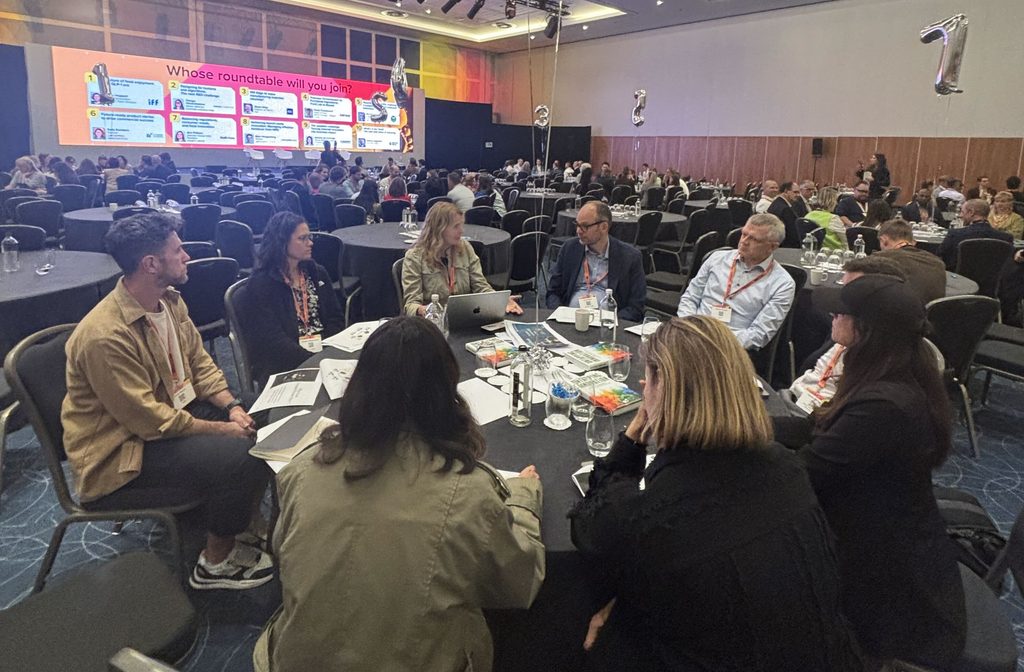
This final theme came through in the presentations, side conversations and our own Future Food-Tech roundtable on creating future-ready Product Stories.
As food innovation becomes more sophisticated, making it meaningful and understandable to consumers becomes increasingly important. Precision fermentation, novel proteins, personalised nutrition and new approaches to healthy ageing all bring potential benefits, but consumers also want greater transparency around what is in their food, where it comes from and how it is made.
Protein provides an interesting example of the power of a strong narrative. It has travelled from specialist sports nutrition into everyday food and drink, supported by positive associations with strength, fitness and active lifestyles. Fibre has an equally important nutritional role, but its consumer story is arguably less developed. What could make people actively seek out fibre in the way many now seek out protein? And how will we create equally compelling stories around the next generation of nutritional ingredients and food technologies?
One of the healthy longevity discussions captured this well: science and transparency help build trust, but consumers also need to understand the benefit. The outcome matters, not simply the ingredient or technology behind it.
So what for R&D?
→ Use Product Story throughout the innovation lifecycle: to help shape product development around a compelling user benefit; create the foundation for go-to-market narratives, claims and demos; and unlock greater value from products already in market.
→ Bring R&D, insights and commercial teams together around the story. A strong Product Story connects what the user wants, what the product delivers and how it delivers it, creating a shared foundation for both product and communication development.
This was something we explored in our Future Food-Tech roundtable, where emerging technologies such as bio-manufactured foods highlighted the challenge particularly well: however complex the science, the reason somebody should want the resulting product still needs to be clear.
Bringing it all together
The opportunity for R&D is significant, but so is the complexity of turning that opportunity into successful food innovation. Success will increasingly depend on keeping the user at the centre while navigating new nutritional needs, greater supply uncertainty, emerging technologies and the realities of commercialisation. That means being really clear about what matters, testing the biggest assumptions early and telling a compelling story about why the resulting product is worth choosing. And, of course, making sure it tastes great.