3 Things Every Food Innovator Should Learn from Beauty
It’s healthy to be curious about what’s happening in adjacent categories because consumers don’t think in categories. Consumers don’t wake up and separate their lives into food, beauty, fashion and technology. They’re experiencing all of it, and expectations transfer between categories. It’s happened already in skincare. Next category is we’ve seen it in hair care, like the skinification of hair and we’re now seeing it in food.
Product development starts with understanding the job consumers are trying to get done, then translating that into meaningful product experiences, clear product stories and technical decisions that R&D teams can act on.
One of the most powerful ways to sharpen that thinking is to look beyond food. We see first-hand how innovation patterns repeat across categories: beauty has already navigated many of the challenges food brands are facing today, from ingredient literacy to consumer storytelling and product communication.
The opportunity for food innovators is to learn from the principles behind its success. Here are three lessons every food innovator can apply to build products that connect more meaningfully with consumers, accelerate innovation and create experiences people genuinely value.
1. Consumers talk differently about beauty and food but, they’re telling you the same thing.
Coming from personal care into food, one of the things that’s really struck me is the difference in the way consumers express what they want. In skincare, you talk to consumers and they will quite often tell you they’ve got a problem. They can really clearly articulate their frustrations and their tensions. However, when you talk to consumers about food, they can’t articulate it in the same way, they run out of language but, they do have desires and wishes, especially in different moments of the day for different types of food experiences.
You don’t have a problem-solution mindset until you really unpick the consumer research and focus on: how do I create a product that will fulfil that or give them that new meaningful experience in that moment.
From a product design point of view, we often see R&D get stuck on: how do we even start to translate the benefits? What do we do with the texture? What do we do with the flavour? What do we do with the colour? What do we do with the ingredients?
The underlying principle is the same, it’s about understanding who are you serving with the product you’re going to develop. To truly understand your consumer you need to understand their needs and what job that product is doing for them in that moment?
See how we helped an FMCG client translate consumer insight into a clear product blueprint using our Untapped Ideal Product Model™
→ Case Study
2. Functional benefits still need an emotional benefit
Food is following the same ingredient journey beauty went through a decade ago. Skincare was all around anti-aging, wrinkle reduction, glow or radiance and then it shifted to being very ingredient-focused. Brands started to focus their product communication on peptides, hyaluronic acid and retinol but, consumers need to understand what the benefit is. The literacy with ingredients is crucial as it’s communicating the mechanisms and functionality of a product.
This parallel is clear across food categories too with the emergence of the nutrient-led approach and ingredient prominence. Consumers aren’t thinking “I’m going to go and buy myself 8g of protein” but they are thinking “I really want a satiating snack to rebuild after my gym session”. This is the priority benefit which needs to be communicated and the protein is the reason to believe. Packaging tells the story long before the first bite. Everybody is becoming much more aware of what’s in their food, much more conditioned to look at what’s in their food.
Discover how we helped transform complex technology into product stories consumers could immediately understand.
→ Case Study
3. Innovation happens when you look outside your own category
It’s healthy to be curious about what’s happening in adjacent categories because consumers don’t think in categories. Consumers don’t wake up and separate their lives into food, beauty, fashion and technology. They’re experiencing all of it, and expectations transfer between categories. It’s happened already in skincare. Next category is we’ve seen it in hair care, like the skinification of hair and we’re now seeing it in food.
The underlying principle is the same: understand who are you serving and what job that product is doing for them in that moment.
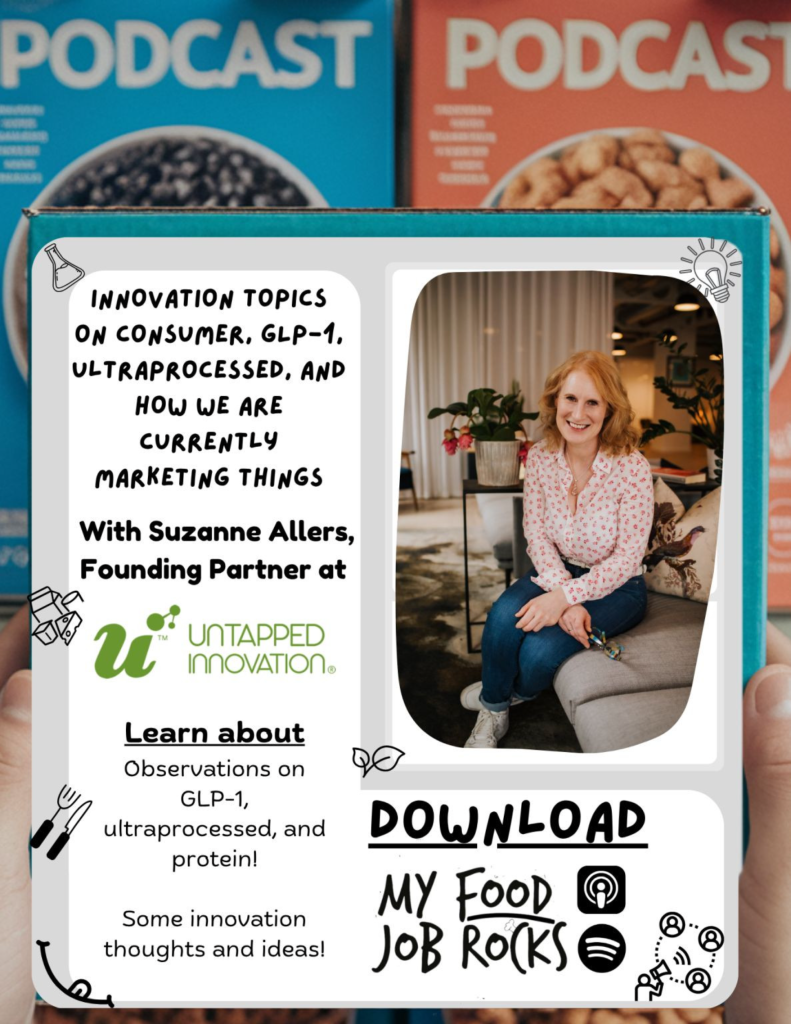
These are just a few of the themes I explored with Adam Yee on the My Food Job Rocks podcast, where we discussed more on consumer psychology, ingredient literacy, GLP-1, storytelling and the future of food innovation.