3 Things a Software Guy and an FMCG Scientist Agree On
Dr. Chad McAllister and I do not come from the same world. He has spent his career in software and product management, and hosts the Product Mastery Now podcast. I have spent mine in FMCG, working inside R&D teams developing everything from antiperspirants to toilet tissue to skincare. When we sat down to record a podcast together, I was super curious to see how much overlap there would actually be. Quite a lot, as it turned out. Three things in particular kept coming up from both sides, and we felt they are worth sharing because they hold across industries, not just in consumer goods.
Dr. Chad McAllister and I do not come from the same world. He has spent his career in software and product management, and hosts the Product Mastery Now podcast. I have spent mine in FMCG, working inside R&D teams developing everything from antiperspirants to toilet tissue to skincare. When we sat down to record a podcast together, I was super curious to see how much overlap there would actually be.
Quite a lot, as it turned out. Three things in particular kept coming up from both sides, and we felt they are worth sharing because they hold across industries, not just in consumer goods.
1. The user tends to get forgotten between the whiteboard and the shelf
Chad opened the episode with a question that has driven a significant part of his career, including his PhD research: why do so many products fail? His answer, drawn from software is not because the technology was bad, and not because the team was not talented or committed, but because the user got forgotten somewhere in the development process.
The data in consumer goods tells a similar story. Somewhere between 70 and 80 percent of FMCG product launches fail in market, and before they reach the market we see rework cycles, late-stage course corrections, and projects that consume months of careful development, arriving market feeling like something a competitor has already launched.
In many cases the science is excellent. What goes wrong is that the human problem was not deeply enough understood before the technical work began. Neither Chad nor I was describing a gap in capability or commitment. Where it tends to occur is in how budgets are allocated and how stage-gate processes are applied. Software, shampoo, or anything in between, the pattern is remarkably consistent.
2. Scientists and engineers want to understand the problem too, when you give them the room
Chad mentioned during the conversation that his best experiences with engineering teams came when he could get the senior architect in front of customers early, before the technical requirements were written down. Without that, the requirements arrived as a document or spreadsheet, harder to interpret and disconnected from any real human contact.
This maps directly onto what we see in FMCG R&D. Scientists and engineers are, in our experience, extraordinarily curious people, and that curiosity extends well beyond the technical solution when they are given the room to use it. In most innovation processes, though, the budget and the structure prioritise the solution. The discovery phase, where you sit with the human problem long enough to understand what is genuinely deficient about current alternatives and why, tends to get treated as an optional preliminary to the real work rather than the foundation of it.
We have watched very talented R&D teams work their way around a problem they did not fully understand, and the rework that follows is always more expensive than the time it would have taken to understand it properly. There is a significant commercial cost to skipping this “root-cause” step. When teams genuinely understand the consumer problem, they typically surface four or five viable technical directions. You have an investable pipeline right there, rather than optimising hard for a single solution without knowing if it is even the right one.
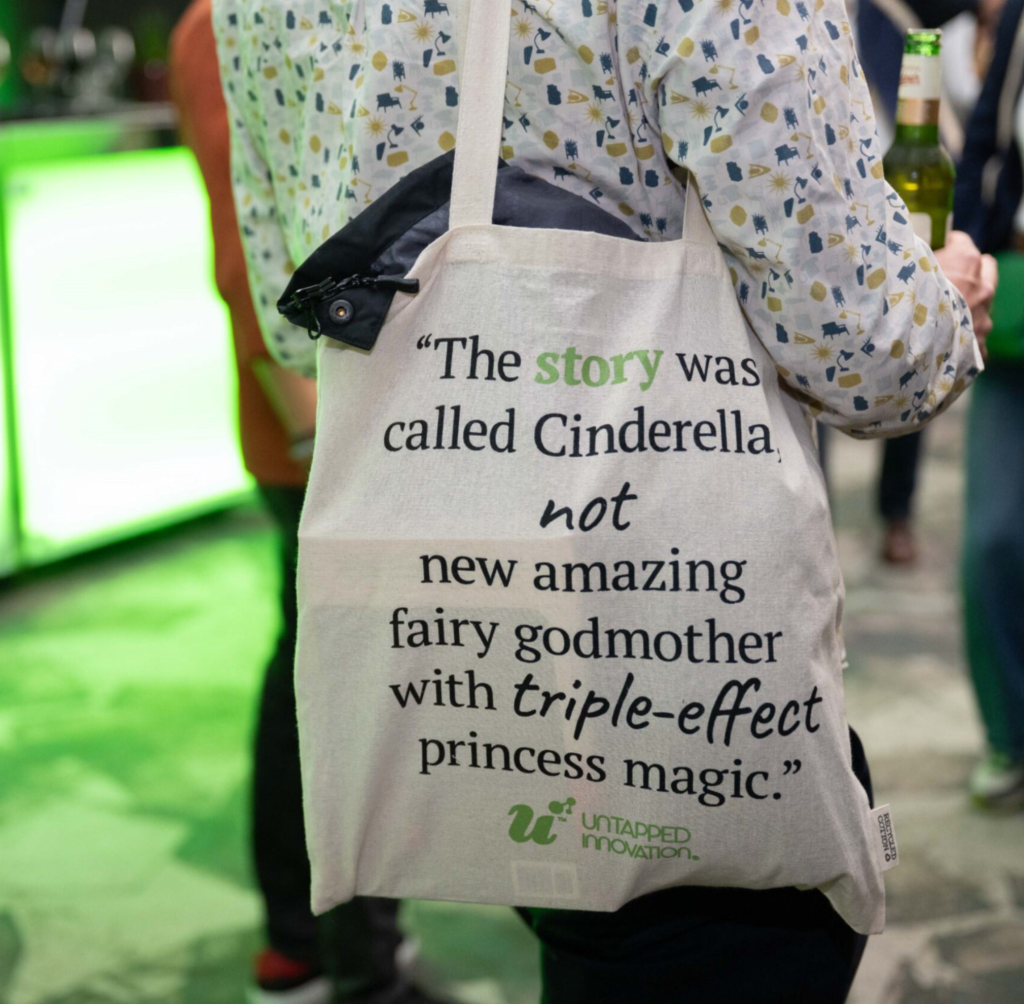
3. The story was called Cinderella, not “New Amazing Fairy Godmother with Triple Effect Princess Magic”
This is a joke we have been telling in client workshops for years, and Chad appreciated it during the podcast, which confirmed to me that it lands across industries. If you run a quick audit on most product communication on a supermarket shelf, around 80 percent of it is talking about the product, the ingredients, the technology, or the delivery system. The consumer, who is supposedly the whole reason the product exists, tends to get around 20 percent of the airtime.
The framework we built at Untapped Innovation, which Chad and I worked through in the episode, is designed to reverse that ratio. We call it the Product Story arc: four chapters drawn from screenwriting principles that a cross-functional innovation team can use. Chapter one is the consumer’s situation and their wish. Chapter two is the root cause behind the problem. Chapter three introduces the technology that addresses it. Chapter four is the new experience that results. The consumer is the hero throughout, and the product is the supporting actor. Seventy-five percent of the story belongs to the consumer’s world.
The Andrex Classic Clean case study shows what this produces in commercial terms. Working with Kimberly-Clark on cleaning efficacy for their toilet tissue range, consumers kept returning unprompted to the microfibre cloth as their gold standard, something three-dimensional that gets into “nooks and crannies” a flat cloth cannot reach. In comparison, flat toilet tissue was perceived to move dirt around instead of “picking it up”.
Six years later, Andrex Classic Clean with their 3-D wave texture remains Kimberly-Clark’s best-ever testing concept and prototype. It blew past internal and external benchmarks, and because the story was grounded in a gold standard consumers recognised immediately, it also convinced the organisation of the significant capital investment required for the new production machinery.
When teams use Product Stories from the start, the results are very consistent. Concept test scores are higher because consumers recognise themselves in the narrative. Development timelines shorten because the direction is clear and teams are not spinning in concept development for months trying to hit green on a scorecard. Getting the Product Story right early can save up to twelve to eighteen months on a project, which matters considerably when launch timelines are always under pressure to accelerate further.

We closed the episode with a quote from James Clear: “you do not rise to the level of your goals, you fall to the level of your systems.” What we have seen across R&D work is that the tools used consistently inside an innovation process are what produce consistently breakthrough results, more than aspiration ever will.
A big thank you to Chad, who brought genuine curiosity and the technical fluency to ask great questions throughout. The full episode is at productmasterynow.com/597, and our book, “Untapping Innovation: An R&D Playbook for Products and Stories That Sell”, covers the full toolkit for anyone who wants to go further.
This blog is based on Deirdre’s appearance on Episode 597 of Product Mastery Now, hosted by Dr. Chad McAllister.