Overcome R&D Challenges and Maximise Return on Investment with a Winning MVP
In today’s competitive landscape, R&D teams are under more pressure than ever to deliver innovative, high-performing products—without blowing timelines or budgets. We’ll explore some common challenges R&D teams face and how a structured, MVP-driven approach can help overcome them.
In today’s competitive landscape, R&D teams are under more pressure than ever to deliver innovative, high-performing products—without blowing timelines or budgets. Many teams invest heavily in refining every detail without first validating what truly matters to the user or the business.
The solution isn’t just better execution—it’s better prioritisation. By adopting a Minimum Viable Product (MVP) mindset, R&D teams can focus on building the simplest version of a product that delivers real value, meets core user needs, and clearly demonstrates a meaningful point of difference. This approach not only accelerates development and reduces waste, but also helps teams make more informed, cross-functional decisions that maximise ROI.
In this post, we’ll explore some common challenges R&D teams face and how a structured, MVP-driven approach can help overcome them.
Challenge “The Price of Perfection”
Behind every seemingly simple product lies years of research, testing, and iteration. Companies invest huge amounts of time and budget into perfecting formulas, textures, packaging, and application methods—all in pursuit of a seamless user experience. Yet, this relentless refinement comes with risks: excessive costs, delayed launches, and products that miss the mark due to imagined “perfection hypotheses” vs. real user needs. The challenge for R&D teams is not just making a product better—it’s knowing when it’s good enough to deliver against the business objectives.
Solution: Create a Minimal Viable Product
Rather than pouring resources into perfecting a product before launch, R&D teams can learn from the tech-world and adopt a Minimal Viable Product (MVP) mindset—focusing on creating the simplest version that delivers core value to users. By developing an MVP, teams can test key assumptions, gather real-world feedback, and iterate rapidly, ensuring they invest in features that truly matter. This approach minimises wasted time and cost, reduces the risk of over-engineering, and helps companies bring innovations to market faster. Perfection is not the goal; validation, learning, and adaptability are.
Challenge: Creating Truly Unique Products
For R&D teams, innovation is not just about making a great product—it’s about making a product that stands out. In crowded markets, products get lost, offering only incremental improvements rather than true differentiation. Companies can invest in technical enhancements or small optimisations, only to find that consumers don’t notice a meaningful difference. The challenge is not just in building something better, but in ensuring it’s distinct enough to capture attention, create value, and stand out in market.
Solution: Create an Attribute Hierarchy for Meaningful Differentiation
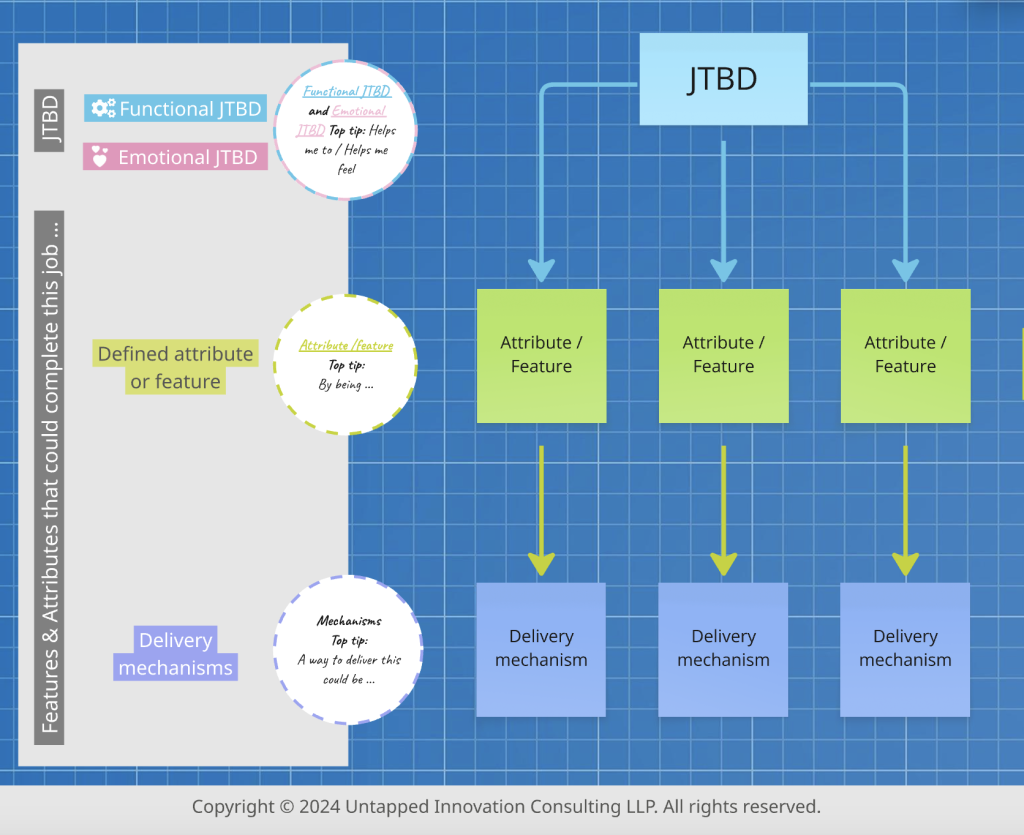
To build a product that truly stands out, R&D teams must move beyond incremental improvements and instead focus on what matters most to users. This is where an “attribute hierarchy” becomes essential.
Starting with all possible functional and emotional user jobs, an attribute hierarchy will help teams strategically identify which attributes are:
1. Core attributes – The essential product features that users expect.
2. Must-have attributes – Features that drive repeat usage and loyalty.
3. Delightful differentiators – Unique elements that create an emotional connection and set the product apart.
By structuring R&D around this hierarchy, businesses can prioritise and invest in the attributes that drive differentiation and impact, ensuring products are both lean and compelling, without getting lost in unnecessary complexity.

Challenge: Striking the Right Balance in Sample Testing
R&D teams often face two opposing challenges when developing new products. On one hand, they may have too many potential ideas or technologies, making it difficult to decide which ones to test and where the biggest knowledge gaps lie. Without a clear framework, they risk wasting resources on low-impact innovations or overlooking game-changing opportunities.
On the other hand, teams can also fall into the trap of narrow thinking, assuming they already have the right solution too early in the process. This can lead to missed opportunities, as they may focus only on refining an existing idea rather than exploring a wider range of possibilities that could deliver greater impact. The real challenge is striking the right balance—broadening exploration when needed, while also prioritising the most meaningful attributes to test.
Solution: Technology Mechanism range-finding
To navigate the challenge of too many or too few possibilities, R&D teams can use technology mechanism “range finding”, a structured approach to identifying the most effective mechanisms that deliver key product attributes for the user.
Rather than assuming what matters to users, teams first determine how users naturally assess the mechanism, for example how quickly a specific ingredient, or combination of ingredients, moisturise the the skin. Once this key metric is identified, teams can then develop a set of technology stimulus that spans the full spectrum of delivery, from one extreme to the other (e.g., very rich to very light).
By having users evaluate and plot these technology mechanisms on a scale, teams gain clear insights about what is ideal, and importantly what is “good enough”. This method ensures R&D teams don’t rely on guesswork—instead, they establish a data-driven technical range specification, helping design products that align well with user preferences.
Challenge: Informed Decision-Making in R&D
For R&D teams, making the right product decisions is not just about having great ideas—it’s about ensuring that all market-relevant information is considered before moving forward. While stakeholders from different functions (marketing, supply chain, finance, etc.) need to be heard, it can be difficult to balance competing priorities and see the full picture.
Decisions such as removing or adding an ingredient may have ripple effects which can impact on cost of goods, manufacturing feasibility, user satisfaction, or regulatory compliance. Without a structured way to assess these trade-offs, teams risk making choices in silos or getting stuck in decision paralysis. The challenge is not just collecting information, but making it accessible, clear, and actionable for everyone.
Solution: A Multifunctional Scorecard for Smarter Decision-Making
To ensure that R&D decisions are both user-centric and strategically sound, teams can use a multifunctional scorecard. This tool captures user preferences while also allowing input from key stakeholders across a variety of functions—such as finance, supply chain, and marketing.
By evaluating each technology decision against multiple clear criteria, teams gain a more holistic view of the trade-offs involved. This structured approach ensures that no critical factor is overlooked, and allows for faster, more confident decision-making that balances user needs with market requirements.

Want to Empower your R&D Teams?
If your R&D team is facing these challenges, you’re not alone. Through our tailored MVP Innovation Gym training we equip R&D teams with the tools, frameworks, and mindset needed to apply MVP thinking to any type of product development. From building attribute hierarchies to using range-finding techniques and multifunctional scorecards, we help you streamline decision-making, prioritise with confidence, and accelerate innovation—without sacrificing impact. Whether you’re looking to optimise a current pipeline or embed leaner, smarter practices into your development process, our MVP Innovation Gym is designed to turn complexity into clarity and maximise your return on investment.
Get in touch to learn how we can support your team in building better products—faster, leaner, and with greater strategic impact.
Written by Aveen Redjep
‘MVP and Prototyping’ Innovation Gym co-creator and trainer.
If you enjoyed reading, you may also like this blog:
5 Big R&D Challenges: How Ideal Product ‘Attributes’ Maximise Innovation Success