MVP’s in the real world: practical tips for R&D
Aveen Redjep, ‘MVP and Prototyping’ Innovation Gym trainer, shares insights on common misconceptions around Minimum Viable Products (MVP’s) and how all R&D teams can use MVP thinking to launch faster, develop smarter, reduce risk, and align well with consumer expectations.
R&D teams are often tasked with delivering products that are technically sound, consumer-preferred, and commercially viable. But too often, companies fall into the trap of over-engineering, over-investing, by focussing on tech features or competitor-matching, and losing sight of what the target consumer actually values. Aveen Redjep, ‘MVP and Prototyping’ Innovation Gym trainer, shares insights on common misconceptions around Minimum Viable Products (MVP’s) and how all R&D teams can use MVP thinking to launch faster, develop smarter, reduce risk, and align well with consumer expectations.
1. “Aren’t MVPs just for apps and tech launches? How does this help with physical product development?”
In Tech, MVPs are used to launch a basic version of a product quickly, gather feedback, and iterate. But in traditional businesses, MVPs can drive earlier, more effective product development, saving time, budget and resources and aligning with user needs from the start.
For those businesses, an MVP might be:
- A low-fidelity prototype to test sensory appeal
- A bench sample with simplified specs
- A small-run pilot batch to trial a formulation
- A concept board or “fake” listing to gauge consumer interest
- A “good enough” prototype for a test market
MVP’s are tools for learning, that help R&D teams reduce risk by gathering real-world data, pressure-test assumptions, and course-correct early before mistakes become expensive.

2. “But we already run user tests during development – how is MVP testing different?”
While many teams do test with users, MVP thinking shifts the timing, purpose, and focus of that testing. In traditional development, user testing often comes late, when the product is mostly complete. The aim is to validate performance and justify progression to the next project stage. This approach is testing to validate what had already been built, yet too late to guide what should be built. Even when testing happens earlier, it often focuses on technical performance only, covering a wide range of variables with no clear prioritisation, therefore increasing costs and time to launch. The user is a checkpoint, instead of a collaborator.
MVP thinking flips that model by putting user needs at the core. It:
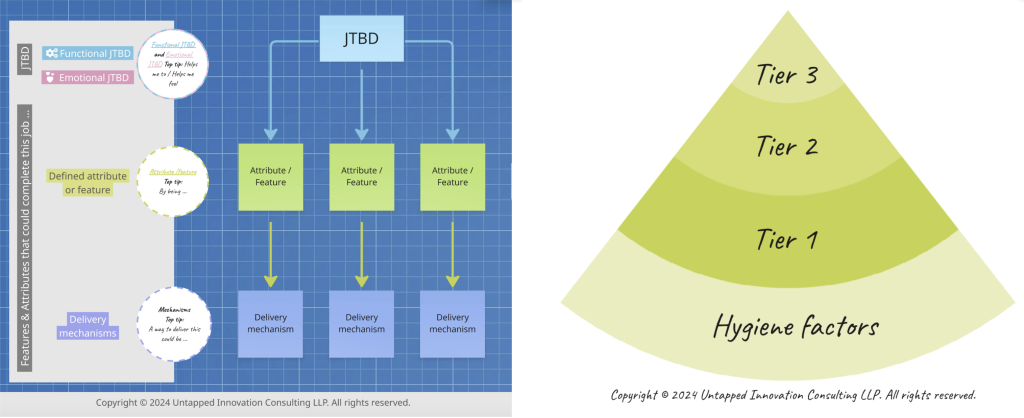
- Starts with the user Jobs To Be Done
- Prioritises product attributes into tiers: core, must-have, and delightful differentiators
Uses user insights to shape technical decisions and define Mechanism Scales (e.g. “good enough” vs. ideal) - MVP thinking shifts the focus from perfection to purpose: asking what’s the minimum that truly delivers value and differentiation, in a way that is good enough.
❌ “Perfect everything, then prove it’s perfect.”
✅ “Figure out what matters, test early, and progress with confidence: lean, focused, and user-led.”
3. “Isn’t an MVP just about the core function? How do we know what else to include?”
MVP thinking is truly strategic, it’s easy to assume that an MVP just needs to deliver the core Attributes. But to succeed, it also has to be usable, desirable, and differentiated, without trying to do everything.
We encourage teams to use an Attribute hierarchy:
- Core attributes: essential to function (e.g. moisturisation, image quality)
- Must-haves: drive emotional satisfaction or repeat use (e.g. fragrances, haptic feedback)
- Delightful differentiators: create standout appeal (e.g. sustainable packaging, sensory twist, unexpected colours)
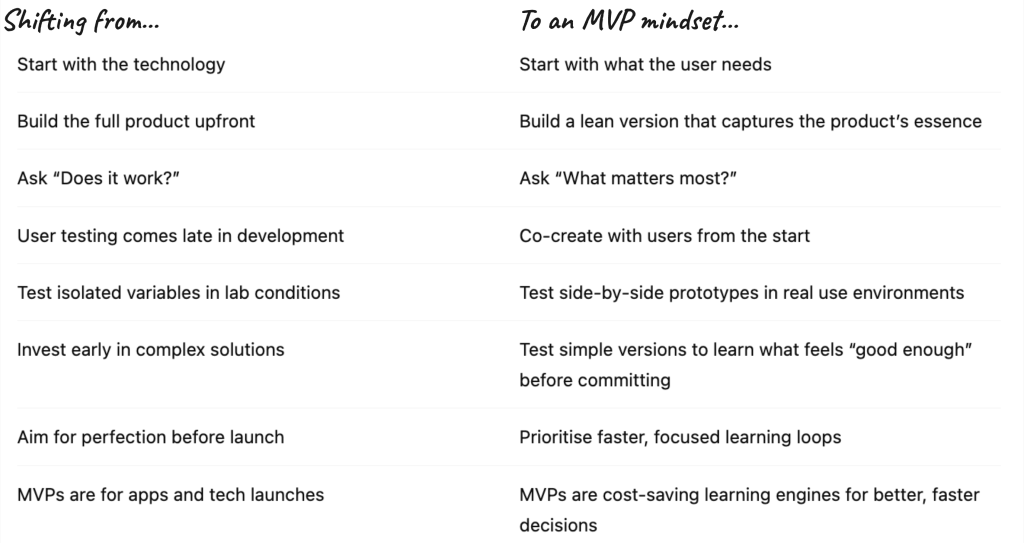
The MVP Mindset Approach

4. “But isn’t launching lean only realistic for small or unregulated businesses?”
It might feel that way, but MVP thinking is often even more valuable in large, complex, or highly regulated organisations. Big businesses face long timelines, high-risk visibility, and cross-functional gatekeeping. The cost of getting it wrong is significant. MVPs provide a way to reduce risk early, before full-scale investment or internal lock-in. This doesn’t mean ignoring compliance. Even in regulated categories, like consumer healthcare, you can break products down and test non-regulated attributes like texture, scent, usability, or first impressions. These often-overlooked elements can create true competitive advantage in saturated markets.
An MVP mindset helps you:
- Prioritise what to test now vs. what can wait
- Align teams earlier around real-world data
- Avoid wasting time on features users don’t value
MVPs are a safe, strategic shortcut to smarter innovation. And for high-stake businesses, that’s not a compromise, it’s a competitive edge.
5. “How can I actually apply this in real projects?“
Understanding the value of MVP’s is important but applying the principles across complex functions, timelines and internal pressures can be challenging. The Innovation Gym offers R&D and cross-functional teams a hands-on course to put MVP into practice with practical frameworks, agile tools and compelling case studies which can be instantly applied to your live projects so you can move forward with clarity, confidence and speed. Whether you’re creating something new or refining an existing product, the ‘MVP and Prototyping‘ training can help you stay aligned with user needs and prioritise what matters most for your R&D pipeline now.

A snapshot from an ‘MVP and Prototyping’ Innovation Gym session
Written by Aveen Redjep
‘MVP and Prototyping’ Innovation Gym co-creator and trainer.
Click here for more expert tips by Aveen